Timber doors can warp when changes in moisture cause different parts of the wood to move unevenly. A door that rubs on its frame or fails to latch can also have a hinge, hardware or fitting problem.
This guide explains what may be causing the difficulty, which checks help establish the cause and how to specify a new external timber door to reduce movement risk.
Why timber doors warp
Timber takes up and loses moisture as conditions around it change, causing it to swell or shrink. How much a door moves depends on the timber used, how it was dried and prepared, the door’s construction, its finish and the exposure of the opening.
Swelling and warping are related but different. Swelling is an increase in the timber’s dimensions as it takes up moisture, which can make the door rub against its frame. Warping is a change of shape, such as a bow along the length of the door, a twist or a cup across its width. The two can occur together.
Wood shrinks and swells by different amounts along and across the grain, and the orientation of the growth rings affects how a board moves, according to the USDA Forest Products Laboratory. Uneven moisture within a component, for example when one face is damper than the other, can also contribute to distortion. Careful drying, handling and storage help limit later dimensional changes, as its chapter on drying and moisture control explains. Well-dried timber still responds to conditions after installation.
Is the door warped or simply difficult to close?
Sticking, uneven gaps and a misaligned latch do not, by themselves, show that the door leaf is warped. The leaf, frame, hinges and closing hardware need to be assessed together. These signs can help you describe the problem to the person inspecting it.
| What you notice | What it could indicate | What should be checked |
| The door rubs in damp weather and eases in dry weather | Moisture-related swelling, possibly with coating damage | The finish, exposed edges and pattern of change with the weather |
| An uneven gap along the closing edge | Leaf distortion, frame movement or loose hinges | The shape of the leaf, frame alignment and fixings |
| The door drops or rubs at one corner | Loose or worn hinges, or movement in the leaf or frame | Hinges and screws, then the leaf and frame |
| The latch will not engage or the seal meets unevenly | Misaligned hardware, a distorted leaf or a frame out of square | Lock and latch alignment, seal contact and frame alignment |
Why the closing edge matters
Borislav Čakarević of Repair A Sash draws attention to the edge opposite the hinges. If this closing edge bows or twists out of alignment, the door may become difficult to close, latch or seal properly.
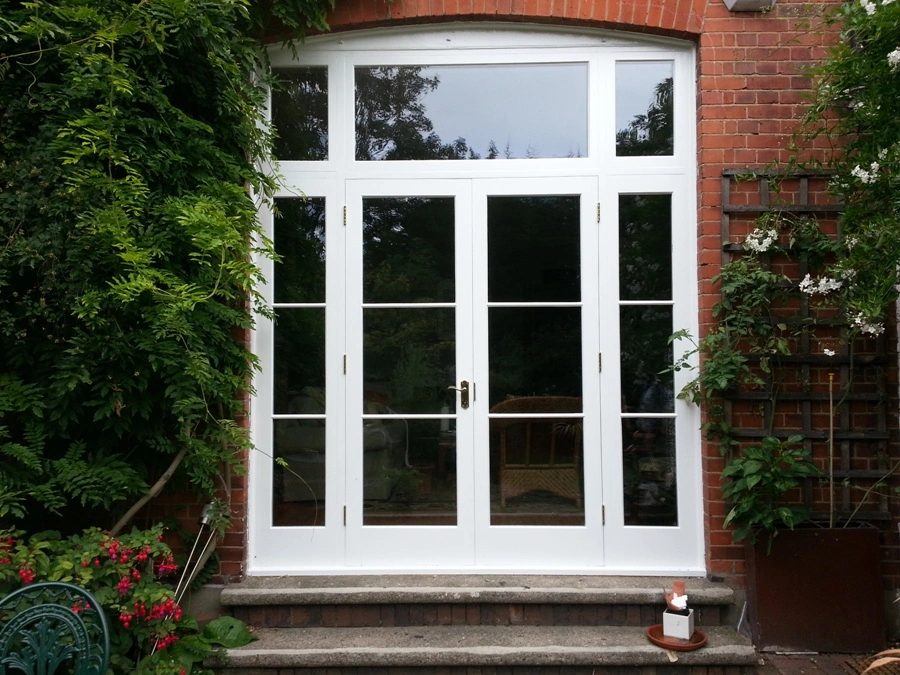
The edge needs to meet the frame, or the other leaf in a pair of wooden French doors, along its height. Distortion can make the door catch on the frame or move the latch out of line with its keep. Uneven contact with the seals can leave gaps through which draughts or water may enter.
How drying and construction affect the risk
Borislav warns that insufficiently dried timber can distort, making preparation an important part of the specification. In the engineered softwood he describes, knots and unwanted sections are removed before selected pieces are finger-jointed together. Removing those sections can help reduce knot and resin problems.
Selecting suitable timber and finger-jointing can help reduce bowing and twisting. Laminating is a separate method of bonding layers or sections together. Door stiles, the vertical members, and rails, the horizontal members, may be made using a combination of these methods. Drying and manufacturing quality remain important, and the finished door needs protection from moisture in service.
Can a different timber reduce warping?
Yes. A timber with better dimensional stability can help reduce moisture-related movement. Dimensional stability describes how much the timber changes in size or shape as moisture conditions change.
Accoya is modified through a process called acetylation. According to the manufacturer’s technical guide, the modification extends through the wood’s cross-section and reduces moisture-related swelling and shrinkage. Compatible coatings, adhesives and hardware, together with correct processing and fitting, remain part of the finished door’s specification.
Hardwood alone does not guarantee that a door will resist warping. Red Grandis and oak are both hardwoods, but their performance also depends on drying, grade, construction and finish.
For a comparison of engineered redwood, Red Grandis, oak and Accoya, see our guide on how to choose a timber for windows and doors.
Finishing and exposure matter too
A coating slows the exchange of moisture but does not stop it. Protection needs to extend beyond the visible faces to the end grain at the top and bottom of the door and the cut-outs for the lock, letterbox and hinges. XL Joinery’s external fitting and finishing guidance highlights these areas because untreated surfaces allow moisture to enter. JB Kind also stresses finishing faces and edges evenly. Follow the instructions for the particular door and coating system.
Once the door is installed, chips and cracks in its coating deserve prompt attention. Accoya’s care guide recommends annual inspection and cleaning, with maintenance carried out according to the coating supplier’s guidance. Annual inspection does not mean annual repainting: renewal depends on the coating, its condition and the exposure.
A door sheltered by a porch faces different conditions from one in direct rain. When specifying a timber front door, discuss how the actual entrance is exposed and whether the design and finish suit those conditions.
What to do if your timber door is sticking or distorted
Keep a note of where and when it rubs. Record any changes with damp or dry weather. This gives the person inspecting the door useful information about how the problem develops.
Look for coating damage and moisture exposure. Check the visible finish, accessible edges and areas where water may collect.
Arrange an inspection before altering the door. Adjustment may be appropriate where misalignment or hardware is causing the difficulty. If the leaf is distorted or deteriorating, an inspection is needed to assess whether it can be restored to proper operation or whether replacement is more sensible.
Planing removes timber permanently, changes the fit and can expose unprotected surfaces. Establish the cause before considering it. If the door will not close or lock properly, have it assessed promptly rather than waiting for the weather to change or forcing the lock.
What to ask when specifying a new timber door
- How is the door constructed? Ask whether its components are made from single pieces of timber, finger-jointed sections, laminated sections or a combination.
- How is the timber dried and prepared? Ask how it is prepared before manufacture to limit unwanted movement.
- Does the specification suit the entrance? Discuss the shelter, aspect and exposure of the opening.
- How is every surface protected? Confirm the treatment of end grain and cut-outs as well as the visible faces.
- What fitting checks and maintenance are included? Ask how closing, locking and seal contact will be checked, and what care the finish needs.
If your existing external timber door sticks, rubs or no longer latches properly, or you are considering new timber doors, contact Repair A Sash to discuss your requirements and the appropriate next steps.
Frequently asked questions about timber door warping
Timber can absorb moisture in damp conditions and swell enough to rub against the frame. The coating, door leaf, frame and hinges should be checked to establish the cause.
No. Swelling increases the timber’s dimensions; warping changes its shape, for example by bowing or twisting. They can occur together, but a swollen door is not necessarily warped.
Yes. Hardwood can move as moisture conditions change. The species, grade, drying, construction and finish all affect how a door performs.
Yes. Accoya reduces moisture-related swelling and shrinkage, but it does not eliminate movement. The quality of manufacture, finishing and fitting also affects how the door operates.
Sometimes. If the leaf is distorted, the severity of the distortion and condition of the door determine whether repair is realistic. An inspection may instead identify a hinge, frame or hardware fault that needs adjustment.
Not as a first step. Planing removes timber permanently, can expose unprotected surfaces and may not address the cause. Have the leaf, frame and hardware checked first.
Reviewed by and sources
Reviewed by: Borislav Čakarević, Repair A Sash
Last updated: 13 October 2026.
Independent references:
- USDA Forest Products Laboratory — Wood Handbook: Moisture relations and physical properties of wood
- USDA Forest Products Laboratory — Wood Handbook: Drying and control of moisture content and dimensional changes
Manufacturer and supplier references:
- Accoya — Wood Information Guide and care and maintenance guidance
- XL Joinery — External door fitting and finishing guidance
- JB Kind — Door care and maintenance and external door care
- International Timber — Finger-jointed redwood and laminated redwood